

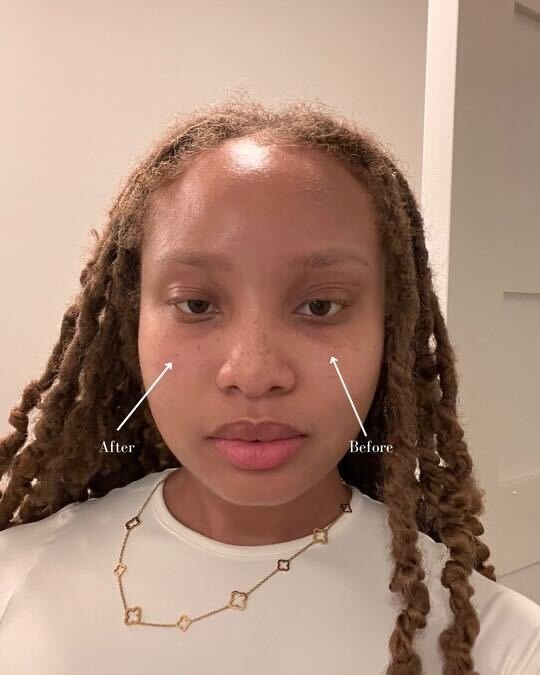
I’ve never been one for needles. In fact, I’ve spent most of my adult life blissfully needle-free, unless you count the annual flu shot or the odd blood draw. When it comes to skincare, my idea of “treatments” has involved drowning in sheet masks or zapping my face with a microcurrent device until my cheeks tingled like static. For years, that was enough.
But lately, one issue has become harder to ignore: my under-eye circles. They’ve been my constant companions, surviving every cucumber slice, every dab of cream, even the occasional desperate application of leftover coffee grounds. Ice? Tried it. Concealer? Runs away by noon. The truth is, no matter what I do, the shadows under my eyes refuse to budge.
So I started doing what any modern beauty sleuth would do: I stalked Instagram. Not just anyone’s Instagram, though—those Instagrams. The fashion insiders with unerring taste, the ones who know the best vintage dealer, the coziest new wine bar, and, most importantly, the derms worth trusting with your face.
One name kept popping up: Dr. Chaneve Jeanniton.
Meeting the Expert
Dr. Jeanniton isn’t just any dermatologist. She’s a board-certified oculofacial plastic surgeon and the founder of Epi.Logic, with a practice in a sun-dappled brownstone across from Prospect Park. (Conveniently, only five minutes from my apartment. The skincare gods were clearly nudging me.) Fashion writer Marjon Carlos swears by her, and by then I was halfway convinced I should too.
So I booked the appointment.
Stepping into her office felt less like walking into a sterile clinic and more like being welcomed into a very chic living room. After a quick round of photos and skin documentation, I sat across from Dr. Jeanniton and laid out my plea: could she do anything about my under-eye circles?
She explained, gently but firmly, that my shadows weren’t just about late nights or bad lighting. They were the result of two things: thinning skin and the beginnings of hollowing around the orbital bone. The long-term solution, she said, was an eye cream packed with retinol and peptides to boost collagen and elastin. But that would take months to kick in. For a quicker fix?
Fillers.
The Case for Fillers
The goal, Dr. Jeanniton explained, isn’t to puff up the under-eye until it looks swollen. Quite the opposite. Done well, filler doesn’t look “full” at all—it simply smooths out the hollow so light bounces off the area, making you appear brighter, more awake, more rested.
But not just any filler will do. Under-eye injections require a special type—low in hydrophilicity, meaning it won’t draw in extra water and cause puffy under-eyes. Restylane, she suggested, is perfect for this delicate area.
I nodded, equal parts excited and terrified.
The Procedure
Here’s what happens when you decide to get under-eye filler: first, the doctor makes a tiny entry point in your cheek with a cannula. From there, she threads the needle to deliver the filler beneath the skin. It sounds harrowing, but truthfully, the sting was brief, and the product itself contained anesthetic that quickly dulled the pain.
What surprised me most was how immediate the change was. After one side was done, I looked in the mirror and saw a softer curve under my eye. The dark trough that had been mocking me for years was noticeably diminished. By the time both sides were complete, I almost didn’t recognize myself.
Then came the flashlight. Yes, the flashlight. Dr. Jeanniton circled me, shining the light this way and that, checking how it bounced off my under-eyes. Reader, this is the true “It Girl” test.
The Aftermath
For 48 hours, I had a list of commandments: no makeup, no sleeping on my face, no workouts, no massages or facials, no alcohol. Basically, live like a skincare nun for two days. I complied, eager to protect my new investment.
To my relief, I had little swelling and virtually no bruising. I even pulled out my trusty LED light device in hopes of warding off inflammation. By day three, I felt… different. Not transformed in an unrecognizable way, but subtly fresher, like I’d finally gotten that elusive eight hours of sleep.
Of course, Dr. Jeanniton reminded me that fillers aren’t a cure-all. They soften the hollows, but true dark circles—especially those caused by pigmentation—need longer-term treatments like retinol. In other words, this was only half the battle. The other half would take months of diligent cream application.
Final Thoughts
So, was it worth it? For me, yes. Fillers didn’t erase my under-eye circles completely (no treatment can, really), but they gave me a softness and brightness that no jar of cream had ever delivered. It’s a tweak so subtle that most people probably wouldn’t pinpoint what’s different, only that I look… better. More rested. Less haunted by my laptop screen.
I still plan to keep up with my retinol eye cream and other long-term fixes. But in the meantime, I have to admit: the world of “tiny tweaks” isn’t so scary after all.
Sometimes, it just takes a little plumping to see the light.